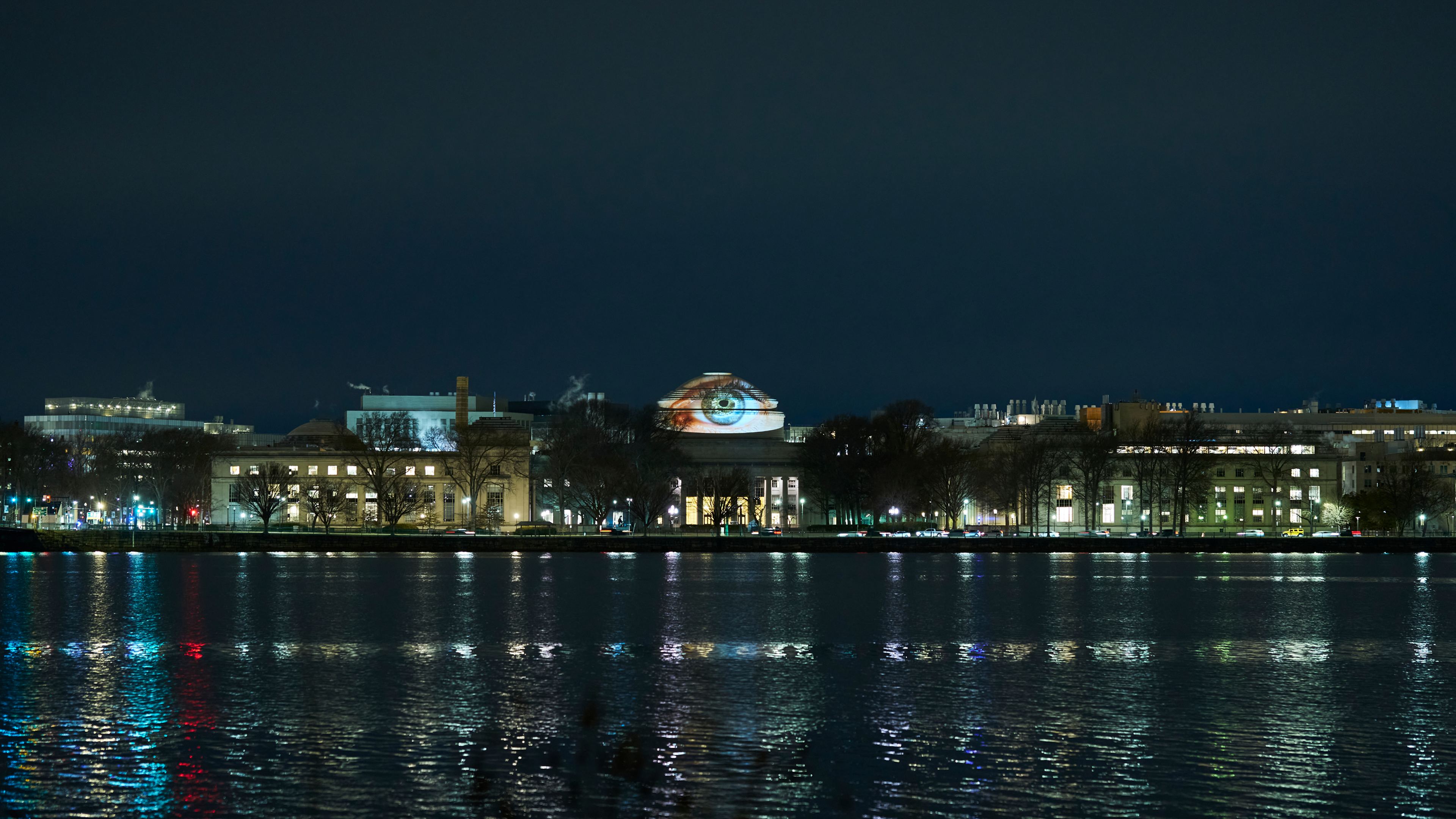
What if architecture could listen?
Inside a private pod, people share personal stories with an AI embodied by MIT’s Great Dome. Their stories are encoded within eyes and projected onto the Dome—turning a moment of reflection into a public experience of being seen.
Enter the pod
Talk with the Dome
See your story
Explore shared stories
A protected space for reflection
The experience begins
with a place to pause.
Privacy sets
the tone.
Inspired by the intimacy of a confessional and the calm of meditation spaces, the pod combines biometric sensing with storytelling.
The enclosure creates a protected environment for participants to share personal dreams, struggles, and aspirations.
An infinity room,
inspired by stargazing.
Light, sound, and spatial framing guide attention away from external distractions before the conversation begins. The mirrored interior gives the participant an immersive setting for self-reflection.
A conversation with the Dome
The building takes
on a listening voice.
The AI’s designed persona is a 109-year-old goddess embodied by the MIT Dome. It introduces itself, guides a meditation, and invites participants to reflect.
LangChain workflows, voice synthesis, and real-time conversation support the exchange. The system responds and asks follow-up questions while keeping the participant’s own story at the center.
- “What do you dream of becoming?”
- “What are you unwilling to feel?”
- “What have you been feeling lately?”
- “What are you longing for?”
Where stories meet the gaze
An eye becomes a vessel
for a personal story.
The eye was chosen to retain emotional presence while aiming to preserve anonymity. Two kinds of input come together: the participant’s gaze supplies the visual canvas, and their spoken narrative supplies the message.
A moving canvas
Tracking keeps the iris structure and movement at the center of the visual translation.
The gaze
Eye capture, iris segmentation, and particle mapping form the visual layer.
The story
A transcript summary becomes Braille, arranged as a code ring within the iris.
A story carried
within the iris.
Personal narratives become hidden messages that invite viewers to look closer.
The moment of being seen
Private reflections,
shared with the city.
onto MIT’s Great Dome
The installation brings individual reflections into a collective public experience. Each eye carries a personal narrative onto a landmark that the city can see.
Seeing my story on the Dome made me feel that my life had been seen by the city. I wasn’t alone.
A participant in Gaze to the Stars
A constellation of shared experiences
Individual stories.
A larger human story.
The experience continues beyond the physical installation through an interactive emotional atlas linking stories, eyes, and participants.
Embeddings, UMAP, and HDBSCAN clustering surface shared themes across the narratives. The visualization offers a way to explore connections between personal experiences.
Machine learning groups related narratives, revealing patterns across individual experiences.
Visitors can rotate the digital Dome and follow links between eyes, stories, and clusters.
See the complete experience.
Project credits & recognition
- My contribution
As a research assistant in the Critical Matter Group at the MIT Media Lab, I led development alongside Professor Behnaz Farahi. I designed the end-to-end participant experience, from the conversational pod to the Dome projection, and developed the human–AI interaction framework while contributing to the software system.
- Team
Behnaz Farahi, Haolei Zhang, Sergio Mutis, xdd, Suwan Kim, Yaluo Wang
- Recognition & publication
NeurIPS 2025
ISEA 2026