
Why
Love is a journey of learning and growth.
Many young couples lose connection amid life’s instability and a lack of guidance in navigating challenges. I wanted to help them develop the skills to understand themselves and each other.
Understanding the support gap
Couples aged 25–30 face complex relationship challenges, yet few have access to reliable guidance that helps them build communication, reflection, and relationship skills in everyday life.
“We experienced communication breakdowns and mismatched expectations that never seemed to get resolved.”Bob & Alice · Couple, age 26

“Relationships are growth engines, not happiness machines.”Christopher Moon · Couples therapist

How
Emotional support and relationship guidance, available in daily life.
The starting point was helping young couples navigate uncertainty, understand their experiences, and grow together. To find an entry point, I examined the barriers that keep people from getting help.
Why doesn’t couples therapy reach young adults?
The research presented in the project described a gap between young couples’ needs and the typical therapy audience: women aged 31+ and men aged 33+. It also identified an average wait of 2.68 years, sometimes up to six years, before seeking therapy.
Cost
$200–600 per session creates a significant barrier.
Commitment
Some couples give up after a single session.
Accessibility
Finding the right therapist takes time.
Stigma
Seeking therapy can feel like admitting that the relationship is in trouble.
Timing
Busy schedules and living in different cities make joint sessions difficult.
Testing demand through social media
I shared relationship education posts to test whether this need extended beyond interviews. The response suggested strong interest in accessible, reliable relationship guidance.
The posts generated hundreds of discussions. Women represented 95% of the audience, an early signal that would later inform how couples joined the product.
The opportunity: meet young couples’ desire to improve their relationships with support they can access and trust.
What
Meet Amimi: an emotionally intelligent relationship guide.
Amimi brings AI and evidence-informed relationship guidance into young couples’ daily connection. The product centers on the couple, offers a companion informed by therapists, and creates opportunities for proactive support.
Support, not therapy.
Amimi focuses on relationship education and everyday support, with referral to therapists when appropriate.
Finding the entry point
The project’s market research cites Harvard Business Review’s 2025 finding that therapy and companionship had become the leading AI use case. The comparison explored how a product dedicated to couples could combine capabilities scattered across existing categories.
Learning through iterations
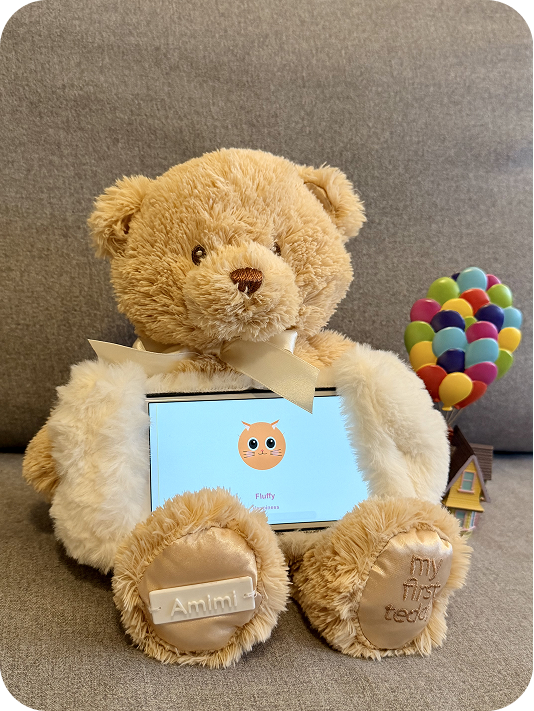
The product took shape through repeated encounters with real couples.
Physical prototype
MVP 1.0
MVP 2.0
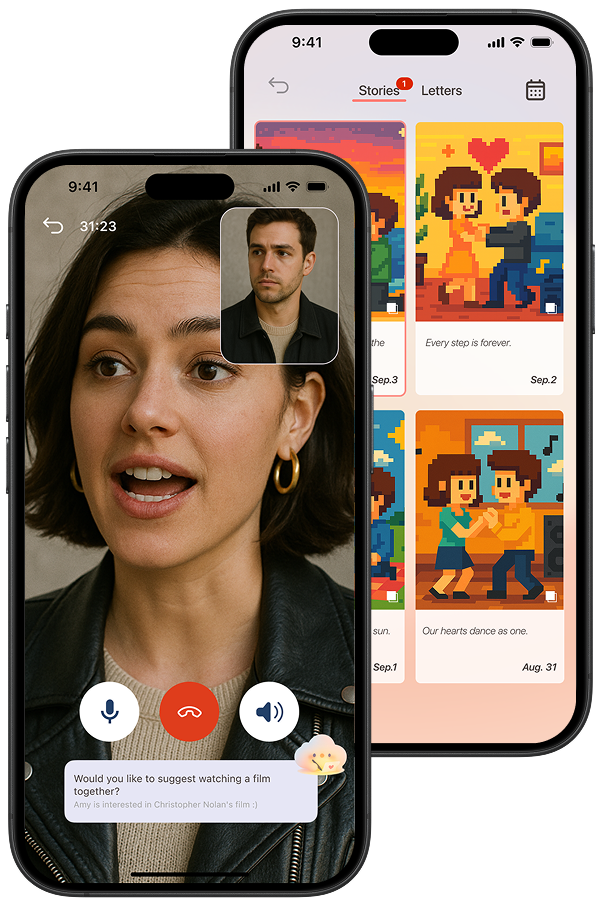
MVP 3.0
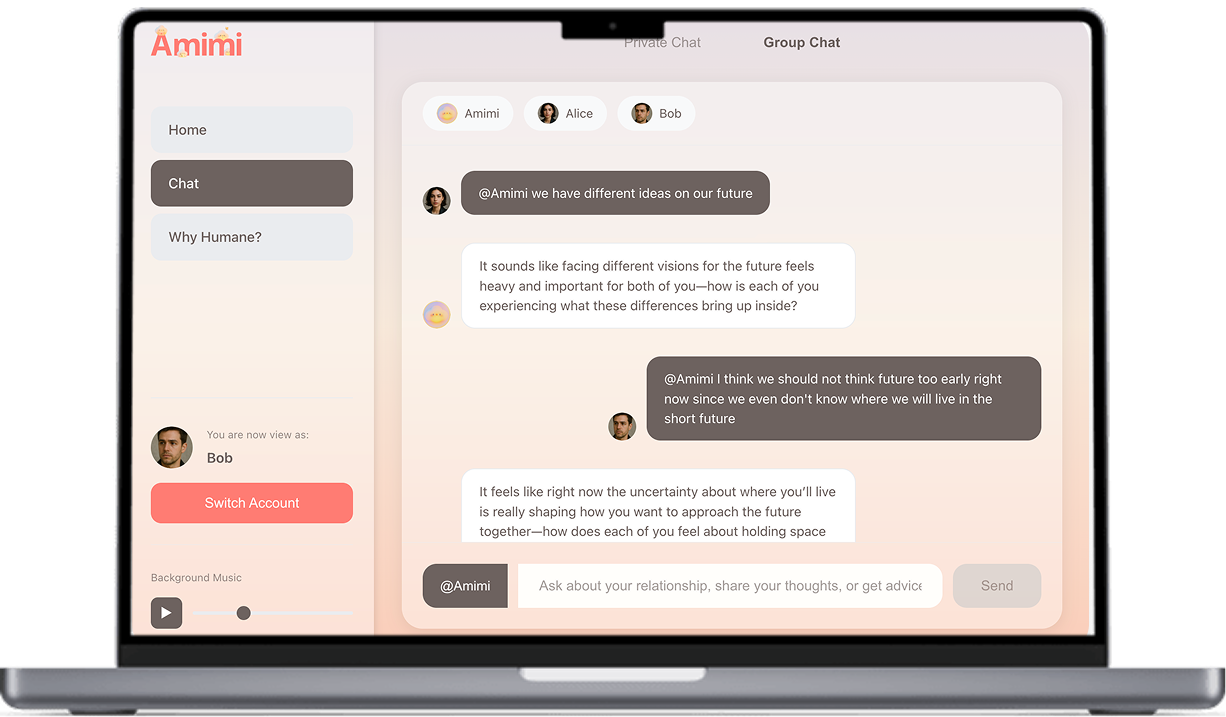
MVP 4.0 / 5.0
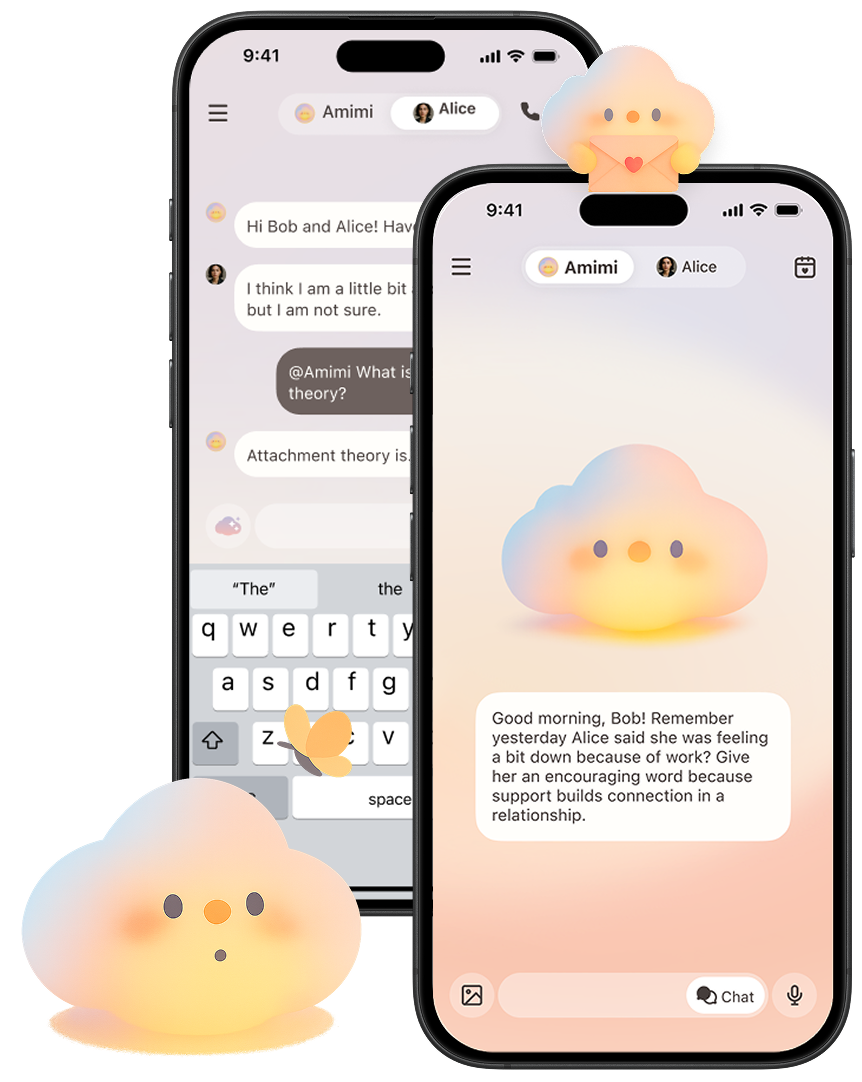
Beta 1.0
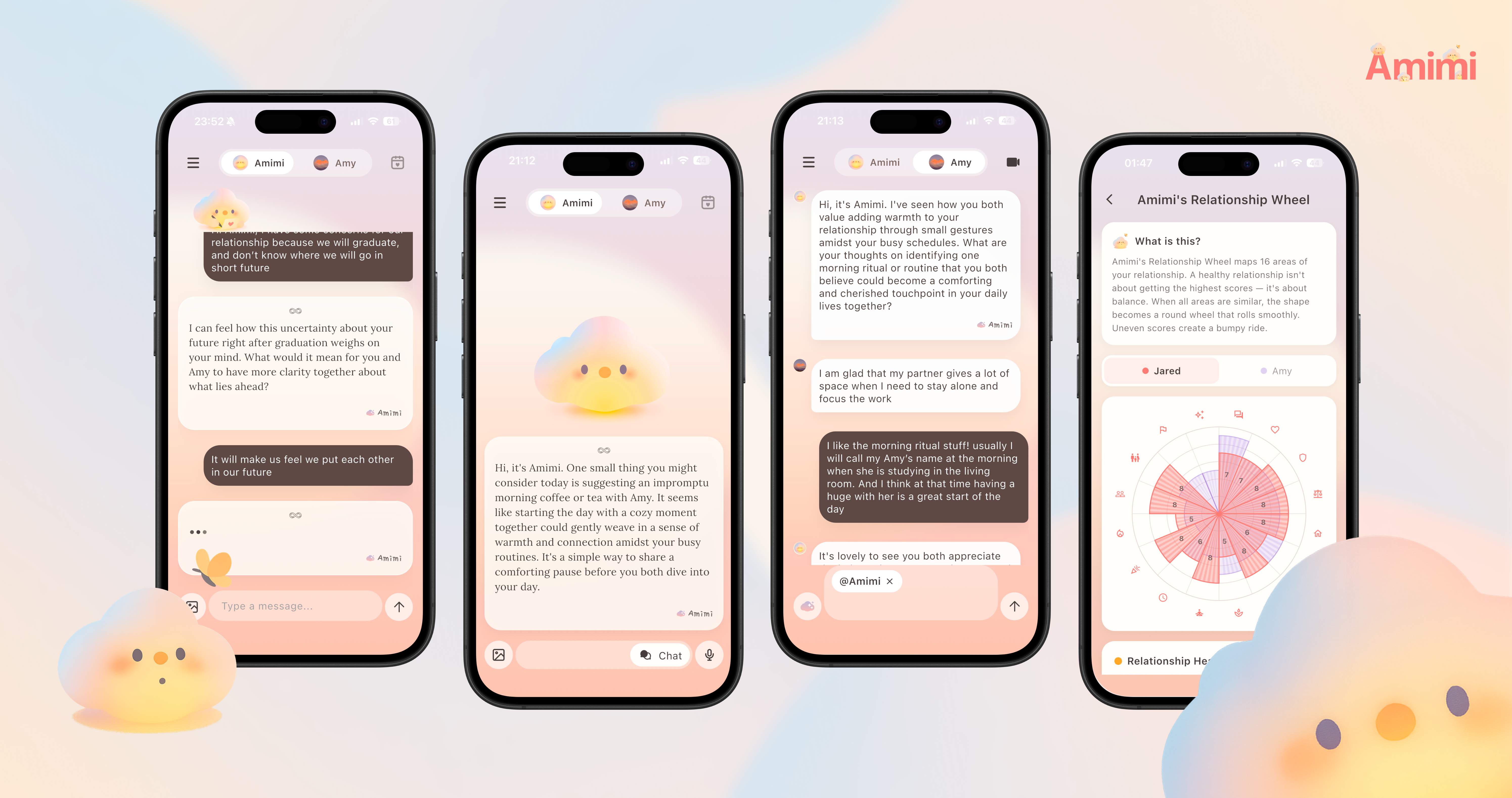
Beta 2.0 · Co-design with therapists
Two decisions driven by user testing
Make it personal
and mobile.
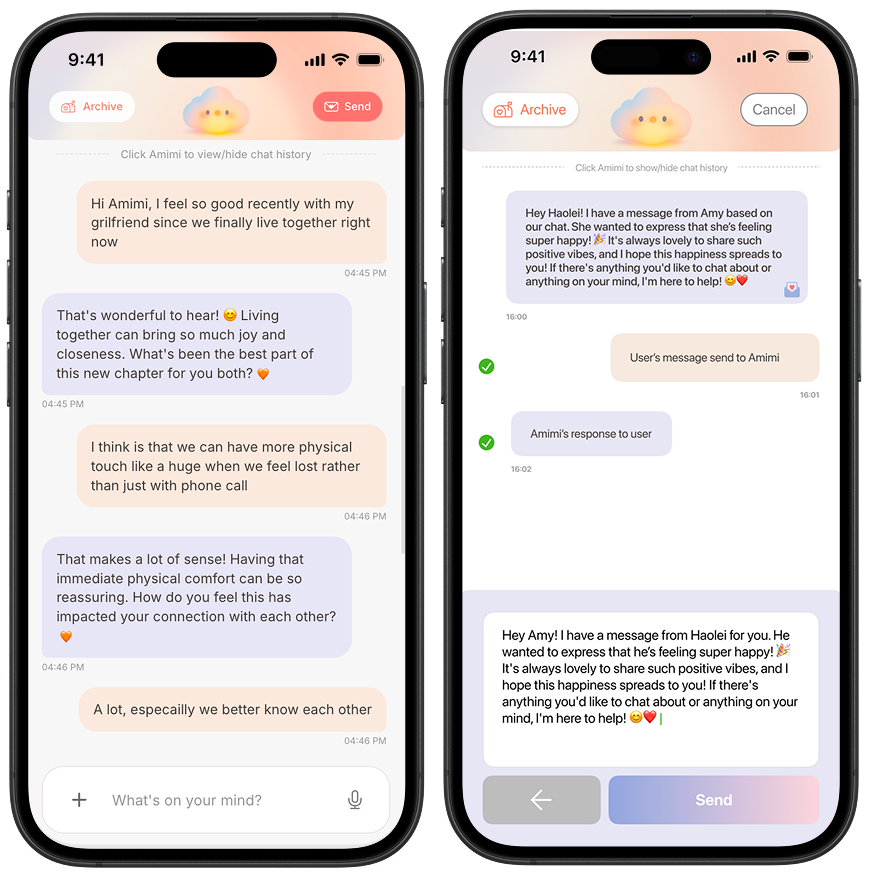
Users preferred mobile-first interactions: accessible, personal, and easy to fit into daily life.
Prioritize a mobile-first experience.
 Physical + web prototypes
 Mobile-first interaction
Give the guide
a character.
Users connected more deeply with a character than a chatbot.
Give Amimi a warm, reflective presence—not just a conversational interface.
Chatbot interfaceAn expressive companionA sunset-inspired cloud spirit, shaped by the Sage archetype.
From mediator to guide and companion
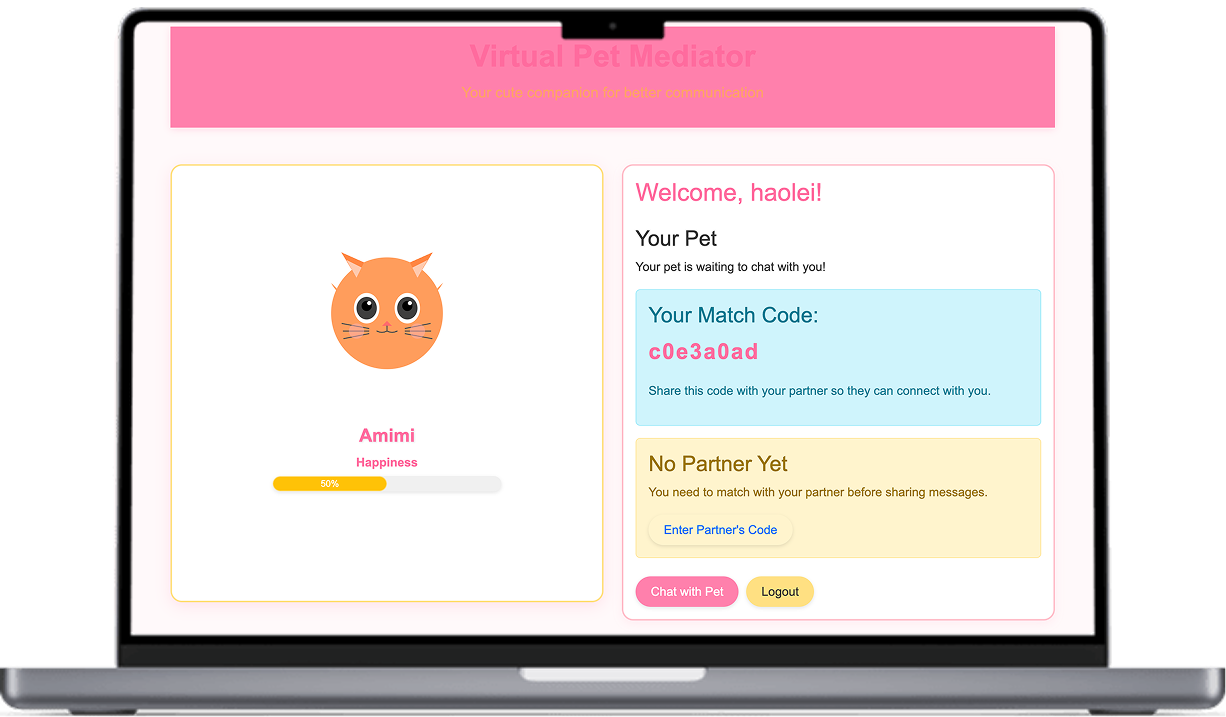
In MVP 2, partners communicated through Amimi. Later versions let people engage individually or together, matching a pattern observed in testing: one partner, often the woman, became the primary user and invited their partner after building trust.
Amimi as a Mediator (MVP 2): Users communicated through Amimi.Amimi as a Guide & Companion (MVP 3–5): Users could engage with Amimi individually or together with their partner.Designing the support system
A therapist-informed framework.
Co-designed with couples therapists. Concepts tested with eight couples.
Support
Emotional support, when it matters.
Curated knowledge · RAG + MCP
Advise
Reflect on needs and expectations.
Analyze
Understand relationship patterns over time.
Research & therapist insight
User feedback exposed three challenges: differentiating Amimi from general-purpose and companionship AI, balancing emotional warmth with evidence-based guidance, and finding the “golden window” for timely support.
I collaborated with couples therapists to develop interaction workflows and validated concepts with eight couples who participated in multiple rounds of MVP testing.
“The key is about finding the golden window, then providing meaningful guidance and support.”Dr. Fatima Aydin · Licensed Psychologist, MA
Translating therapeutic workflows into an AI agent
Working with couples therapists, I translated CBT case formulation into a LangGraph agent with RAG and MCP. Individual and joint sessions span 36 conversational states.
CBT case formulation
- Hearing the storyExploration
- Hypothesis generationEvaluation
- Further assessmentValidation
- Golden windowTiming for intervention
- Intervention
- Psychoeducation
Session orchestration
LangGraph implementation
Scroll horizontally to follow the flow. Select either graph to inspect the conversational states.
The psychological models
The Relationship Wheel
Sixteen dimensions across five categories help partners compare perceptions and identify gaps in expectations, needs, and satisfaction. The categories cover the core relationship, shared life, individual growth, shared experiences, and social context.
Attachment analysis
Attachment concepts give users language for reflection, then space to explore their experience in conversation—without assigning fixed personality labels.
Engineering framework
Psychological models guide reasoning and decisions. Agentic workflows guide timely interventions. Therapist-curated retrieval and user data provide the system’s knowledge.
Software architecture
Frontend
Flutter (Dart) mobile app with Rive state-machine animation and interaction.
Pairing service
Java / Spring Boot manages pairing codes, partner relationships, and pair-related data.
Chat service
Java / Spring Boot handles messages, WebSocket communication, profiles, notifications, and coordination with the AI service.
AI service
Python / FastAPI provides conversation guidance, attachment analysis, daily suggestions, discussion prompts, and Relationship Wheel analysis using LangGraph, LangChain, OpenAI APIs, and FAISS.
Data & deployment
Firebase Authentication, Cloud Firestore, Firebase Storage, and Google Cloud Storage. The app is distributed through TestFlight, with backend services on Railway and Firebase / Google Cloud Platform.
The experience
Follow Alice and Bob’s journey with Amimi.
Onboarding & daily assessment
Alice joins Amimi and completes onboarding and the Relationship Wheel assessment, helping the system understand her emotional state and relationship dynamics.
Individual session
Through one-on-one conversations, Amimi provides emotional support and relationship guidance. As trust grows, Alice invites Bob to join.
Proactive support & joint session
After a communication breakdown, Amimi initiates a joint session, helping Alice and Bob understand each other’s perspectives and underlying concerns.
Proactive suggestion
Following the conversation, Amimi provides personalized reflections and recommendations to strengthen communication and relationship skills.
Testing & impact
The north star: better relationship understanding.
Pre- and post-engagement interviews tracked communication, emotional awareness, and partner understanding. Monthly progress was tracked through Amimi’s Relationship Wheel.
Early Beta 2.0 findings. Interviewed couples reported improvements in communication, conflict resolution, and mutual understanding. These are product-testing results and self-reported scores, not clinical efficacy measures.
Behind the iterations
Usability testing
From MVP 5 through Beta 2.0, each iteration was evaluated with five users randomly selected from the waitlist.